
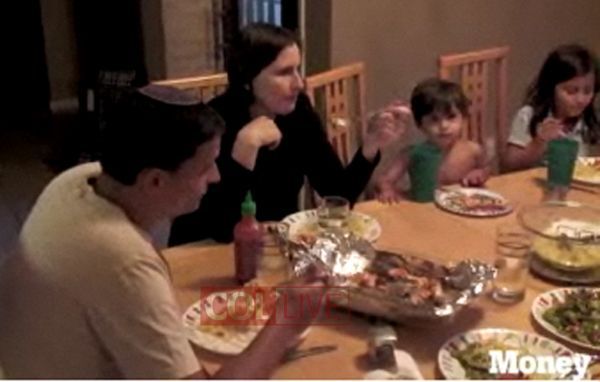
Ask Abbi Perets about financial pain, and she starts talking about grape juice. Specifically, she’s referring to the half-gallon bottles of grape juice that her local grocery sells for $9 each.
Drinking the juice is an integral part of the prayer ritual that Abbi, her husband, Guy, and their four children follow every Friday and Saturday to commemorate the Jewish Sabbath. Like all the food in the Perets household, the juice must be kosher – that is, prepared according to Jewish dietary laws. And the $9 juice, more than three times the price of the regular kind, is the only kosher grape juice she can find.
It is impossible to put a price on religious belief. But as Abbi Perets knows from her trips to Kroger, exercising that belief doesn’t come free. For the most devout practitioners – perhaps 15% of Americans, if measured by how frequently they attend services – following their faith’s precepts often has a profound financial impact: Religion guides how they make, spend, and invest their money. And it often leads to financial decisions and stresses far different from those of people who don’t share their beliefs.
To explore how religion affects the way people manage their money, we visited with three families of different faiths who are struggling to reconcile their spiritual beliefs with their wallets. Their stories, and our advice to them, follow. What all three households have in common: the desire to let faith guide their economic prospects, without undermining their family’s security or long-term goals. As you’ll see, that isn’t always an easy task.
The Perets family
Coping with the cost of keeping kosher
It’s not just the $9 grape juice doing damage to the Perets budget. The kosher mozzarella that Abbi uses to make pizza costs $5, double the price of the non-kosher kind; brisket, the quintessential Jewish comfort food, costs a whopping $14.99 a pound vs. $1.99. It all adds up to a monthly grocery bill of more than $1,000 for Abbi, 33, Guy, 36, and their four kids, ages 3 to 9 (a fifth is due in July).
But for Abbi and Guy, buying kosher food, no matter what the cost, is a necessity, not a choice. They’re Orthodox, which means that, of the roughly 5 million Jews in the U.S., they’re among the 13% whose practice of Judaism hews most closely to the Hebrew Bible’s literal commandments and to centuries of rabbinical instruction.
That means eating only kosher food and keeping meat and dairy products separate. It means doing nothing classified as work on the Sabbath, or Shabbat – even riding in a car. It means sending their children to a private religious school so that they become steeped in the traditions of their faith. Says Guy: “Kids that go to public school – a high percentage of them lose their religion.” And each of those practices comes with a high price tag attached.
Abbi and Guy met and married in Israel. She was an American Jew who dropped out of college to live there; Guy, a native Israeli, was an air force officer. They moved to the U.S. in 2000 and began shopping for a home near Los Angeles. A top priority: finding a house inside what’s known as an eruv, a symbolic wall around an Orthodox community that permits certain activities, such as pushing a baby stroller, that are otherwise forbidden on Shabbat.
Houses within the eruv cost more than those outside it; homes within walking distance of a major synagogue are even more expensive, given the prohibition against driving on Shabbat. The house that the Peretses bought, a half mile from the synagogue, cost $295,000 – at least $50,000 more than homes just a few blocks farther away.
Guy, a developer for a banking software company, and Abbi, a freelance writer, were then making more than $100,000 a year. But they felt squeezed by the high cost of California living. So after researching Orthodox communities in other areas, they decided to move to Houston.
Using part of the $300,000 they made selling their Los Angeles home, they bought a three-bedroom house just a three-minute walk from their new synagogue for $270,000 – about $100,000 more than they would have paid for a similar home in a non-Orthodox neighborhood, Guy says. They spent another $30,000 renovating the kitchen. Among the upgrades: putting in two sinks, two ovens, and two dishwashers – one for meat and one for dairy.
But while it is cheaper to live in Houston, the couple’s expenses have grown. Their third child, Adi, was diagnosed with Sotos syndrome, a condition marked by accelerated physical growth but delayed mental development, which has caused their out-of-pocket medical bills to soar. Meanwhile, the everyday expenses of living Judaically keep adding up. The biggest is private school tuition for the kids. (Only Adi goes to public school, so he can attend special-education classes.) Total tab, after financial aid: $18,000 a year.
The Peretses also give regularly to their synagogue and community. Annual dues are $600; plus, as is customary, they sponsor meals for the congregation, at a cost of about $500, to celebrate happy occasions, such as a child’s birthday. As is also tradition in Orthodox neighborhoods, panhandlers often ring their doorbell with an introductory letter from a rabbi, asking for charity. Most of the time, Abbi gives.
The Peretses now earn $135,000, but they’re still feeling squeezed, particularly since Guy’s employer just cut salaries 5%. They’re anxious about how they’ll keep paying religious school tuition year after year, particularly with the added expense of another child. With Guy’s 401(k) down 50%, they’re also worried about the long term, like how they’ll pay for Adi’s care when he’s older.



Somehow Hashem will provied. Does he not decied what we will make each year on Rosh Hashana, and that does not included the money spent on Chinuch. I grew up with one sink, one oven, and one dishwasher microwave/oven for milchig. Somehow we managed to keep kosher.
its wonderful seeing yidden around the world serving Hashem!!!!!!!!!!!
sounds like its more a part of their menu than just an example
(and btw, what is a Jewish comfort food? i never heard of such a thing!)
#1, that’s what i thought also!! It’s great that they’re so strong in their yiddishkeit as far as buying kosher food, and the other things they talk about, but now, why dont they do the same thing with the average frum (i mean really frum) family, whether its lubavitch or not, and compare the living expenses with the salary!!! i think the results will be a bit more drastic….
I think they talked about the price of brisket as an example. Even chicken, though, is much more expencive than non-kosher here in NY and usually, “out of town”, kosher meats are more than NY.
I admire their mesiras nefesh.
she spoke about education relisten to the tape
emnuah emunah emunah
did they forget the biggy: tuition?
NY is really high as far as living expenses. Houses in CH go for way more than Houston, thats for sure.
Im astounded! Last time I checked Brisket was a luxury. Why do they must have it? Someone fill me in.