
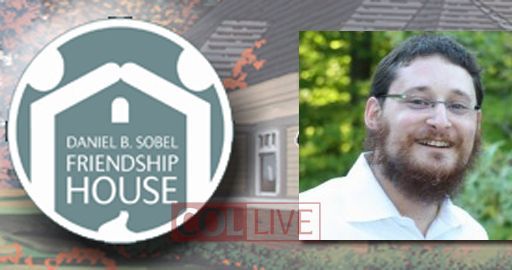
Rabbi Yisrael Pinson is director of the Daniel B. Sobel Friendship House in West Bloomfield, Mich. Since joining the Friendship House, he has helped create a local Jewish Recovery Community where recovering addicts are helped through support, guidance, friendship, and community. Rabbi Yisrael facilitates Jewish Recovery meetings, where recovering addicts from all 12-step programs meet and share regularly. He also teaches classes on Judaism & Recovery.
Menachem Wecker interviews Rabbi Pinson:
MW: Do you think there is a such thing as Jewish art per se? Why?
YP: I think that when people say Jewish Art they can be referring to the following:
1.Art created by Jewish people, but that doesn’t necessarily have any Jewish theme to it.
2.Art that depicts Jewish objects of figures, but not necessarily created by a Jewish artist.
3.Art that is inspired by Jewish beliefs and Torah teaching.
To me the first two are art that incidentally happens to be related to a Jewish person or item. I believe that certain art is derived and inspired from Jewish values. I would call that Jewish Art.
MW: Who are your favorite Jewish artists?
YP: I don’t have any. The only art that I seek out, is the art of song. I really enjoy old Chassidic melodies.
MW: Is it your sense that Chabad in particular, and Chassidim in general, tend to be more supportive of the arts than their mitnaged peers? To what extent is it your understanding that the Rebbe supported the arts?
YP: I would like to believe that Chassidism allows for the expression of the emotions more than other groups. If we look at art as the expression of the soul, it will make sense that Chassidic leaders showed great interest in the art of song, and some in the art of painting. The previous Chabad Rebbe, Rabbi Yosef Yitschak Shneersohn, recounts a particular episode when he visited Vienna with his father, the Rebbe RaShaB, and his father spent hours in the museum looking at paintings of Raphael. There are Chassidic stories that recall the time they went together to a concert hall to attend a philharmonic performance.
MW: Does idolatry still exist today? Are there things you would not hang on your wall for fear that they violated the second commandment?
YP: Idolatry is alive… Have you ever visited India or Thailand? People still worship all kinds of gods, and really believe that certain inert objects have power over them. For the record I don’t have FEAR of violating any of the commandments… I believe that have a different relationship with G-d… I try my best not to transgress any of the 613 commandments, including the one prohibiting idolatry. I wouldn’t have any kind of statues in my house.
MW: Would you enter a church or another non-Jewish place of worship to see art? Is it permissible for Jews to enjoy art of other faiths?
YP: It is prohibited to enjoy or benefit from anything that is related to idolatry, including the joy of art.
MW: Can painting constitute a mitzvah and/or prayer? Could it ever replace formal prayer with a siddur and a minyan, or would it have to be in conjunction with that?
YP: Painting can be a from of spiritual expression, if it has a purpose of bringing more G-dliness into the world. It cannot replace a formal prayer that we are obligated to recite, but can definitely supplement it. That doesn’t prevent anyone to pray to G-d on his own, using any form of expression that is not prohibited in the Torah. At times I connect by singing a melody, sometimes I read a chapter of Psalm. Prayer is the act of connecting, and I believe we can connect beyond the required readings.
MW: Chabad is perhaps the Jewish community that most engages in outreach to non-observant Jews. Do you think art can play a role in this outreach, whether to less connected Jews or to a larger non-Jewish public?
YP: Absolutely. The Rebbe always encouraged artists to utilize their talent and influence to reach out to people that would otherwise not been exposed.
MW: Since this conversation originated on Twitter, who are the most important Jewish voices on Twitter in your estimation?
YP: I haven’t seen enough original Jewish thought emerge from Twitter yet. For now we see a lot of the bloggers, and old media that utilize Twitter to promote their material. I like @JewishTweets it encourages followers to take actions in their Judaism in an original way.

This rabbi knows how to answer questions that is both politically correct, and also informative, insightful, and truthful!!
But why is it all about art?
very nice
For those interested in the original post (with links), please see http://www.iconia.canonist.com/2009/06/10/8-questions-for-rabbi-yisrael-pinson/
Thanks, Menachem Wecker