

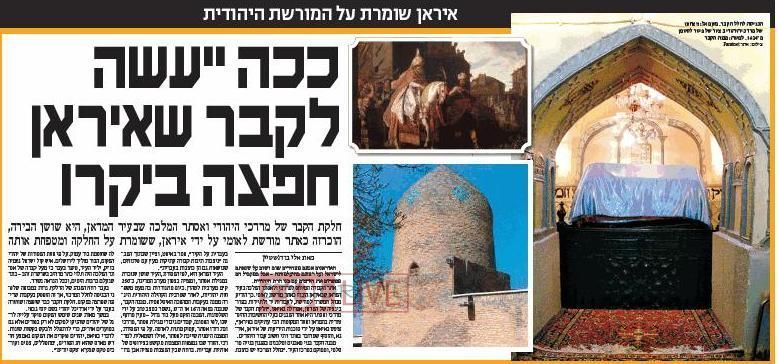
Today it was reported that the gravesite of Mordechai and Esther of the Purim story, located in Hamadan, Iran, which is known to have been the ancient city of Shushan, will be designated as a national historical landmark.
Ma’ariv newspaper notes that this is ironic since the Iranians are known to be against the state of Israel; yet they are working on repairing ties with the Jewish community in Iran.
“The burial site, which in Iran is considered to be that of Mordechai and Esther, is to be called a national historical landmark,” says the Tourism Director of Hamadan. “This particular burial site is one of great historical significance to the country of Iran, as well as to those of Jewish faith.”
The Muslim-style building is located in the center of the city and its walls contain Hebrew inscriptions. Inside there are ancient coffins with ornate wood carvings, that also contain Hebrew writings.
Hamadan is traditionally known as the ancient city of Shushan that is mentioned in the Megillas Esther, located about 250 kilometers west of Teheran. Today there is a very small Jewish community there, since most Jews fled the Islamic revolution.
However, contrary to this report, COLlive has discovered in our archives a photo of what seems to be the sign leading to the graves of Mordechai and Esther, purportedly somewhere in the North of Israel. It certainly is not from Iran.
The question remains: which is the authentic gravesite?



This is quite interesting, I wonder which is the real one. It would make sense that they would have been buried in Iran though, since Esther was the queen there…
I once did a whole article on this issue for Mishpacha Magazine, research and all. The answer is: teiku. Traditional sources equally indicate both places. (By the way, the sign points to a site just outside modern-day Kfar Baram near Tsfat. On top of a wooded hill there is a pile of stones that is a collapsed shrine of sorts said to be the burial place of Mordechai and Esther. So no one really knows.