
By COLlive reporter
Photos by Itzik Roytman
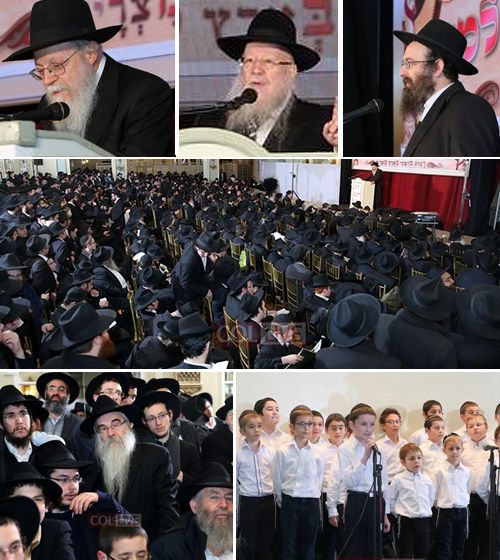
“The Siyum HaRambam Haolomi,” as the Rebbe called it, was held in grand celebration this year in Crown Heights on Isru Chag – the day after Simchas Torah.
The location was the hall of Oholei Torah-Oholei Menachem. At the designated time, thousands of Jews streamed there to celebrate the 35th cycle of study of Rambam’s code of Torah law, Mishneh Torah.
The event started with recitation of the Rebbe’s present chapter of Tehilim, Psalm 115, by the renowned chazzan, R’ Shneur Zalman Baumgarten, repeated verse by verse by everyone present.
This was followed by video clips of the Rebbe speaking about the study of Rambam and celebrating its completion, for it is the Rebbe’s directives that motivate every one of the hundreds of thousands who study it to do so daily. Seeing the Rebbe and hearing his voice aroused everyone’s deepest feelings of yearning to be reunited with him very soon.
The Rabbonim of the community were invited to speak about the importance of this study.
Rabbi Avrohom Osdoba, explained the concluding paragraph of Mishneh Torah, that “the Jewish people will be great scolars, knowing secret matters and understanding the intellect of their Creator.” He showed how these three levels correspond to the three reasons for the creation of the universe explained at the beginning of the Rebbe RaShaB’s profound work, Hemshech Samech-Vov (5666).
Rabbi Yosef Braun, spoke about the differences we find between the various listings of the 613 mitzvos that the Rambam writes (in Sefer Hamitzvos and the beginning of Mishneh Torah). He called for further research into the reasons for these differences, giving a number of interesting examples.
Unique Timing
Rabbi Shmuel Butman, director of the Lubavitch Youth Organization and chairman of the Committee for the World Siyum Harambam, emphasized the uniqueness of this year’s siyum.
This year’s siyum, he explained, is unique in many ways compared with those of previous years. This is the first time that the same day (Shabbos, 20th Tishre) we completed Mishneh Torah, which encompasses the entire Oral Torah, we also completed our study of the entire Written Torah, the five Chumashim, in our daily study of “ChiTaS” (initials of Chumash, Tehilim, Tanya).
Remarkably, the Written Torah concludes with the verse “Ul’chol hayod hachazokoh… asher osoh Moshe” (“And by the entire strong hand… that Moshe accomplished”) – a clear allusion to the Mishneh Torah, also known as the Yod Hachazokoh, that Rabbi Moshe ben Maimon, Rambam, composed.
“The Talmud (Sukka ) states that “Whoever makes a bond to the festival with [superior] food and drink [on the following day] is considered by Scripture as if he has built an altar and offered a sacrifice upon it, as it says [Tehilim 118:27], Isru Chag ba-avosim ad karnos Hamizbeach” –‘Bind the festival offering with thick cords [until you bring it] to the horns of the altar.'”
“This year, the actual completion of the Rambam study was on the day before Hoshana Rabba, while the siyum celebration is being held on Isru Chag of Sukos. This implies that the Rebbe is binding the holiday, with cords of love and Torah, to the day after the holiday, extending the great rejoicing of completing the Torah into Isru Chag. The night after Shabbos was Hoshana Rabba, when everyone completed reciting the whole book of Tehilim (Psalms), the following night was Shmini Atzeres and the first Hakofos, the next night was Simchas Torah and the second Hakofos, and on the next evening was the farbrengen extending Simchas Torah into the following night. And tonight, Rabbi Butman continued, is the first weekday allowing an opportunity to make the siyum celebration of the Rambam, so that the Rebbe has “bound” this extra day of celebration to the previous festive days.
“What is the meaning of the verse of Isru Chag, about tying the festival offering to the horns of the altar? Rabbi Butman asked. The commentaries explain that the Jews who came for the Sukkos to the Beis Hamikdosh were unwilling to leave, and they remained there an extra day, making it into an extension of the Yom Tov by offering extra shlomim sacrifices on that day, tying them to the Mizbeach.
“The Aruch Hashulchan adds that this extra day was necessary in order to complete the eating of the Korbon shlomim that all Jews who came to Yerusholayim brought, which could be eaten for two days and the night in between. They needed the extra day of Isru Chag to finish eating the Korbon Shlomim. Likewise, the present celebration is a continuation of the actual siyum of study that took place during the Yom Tov of Sukkos.
“The Rabbinic encyclopedia, S’dei Chemed (republished here in America by the Rebbe himself), brings what seems like a Chassidic insight: Since, outside the land of Israel, we observe a second festive day of every holiday, the residents of the Holy Land want to be at one with their brethren in other lands, so they instituted the observance of Isru Chag on that same second day.
“Another unique aspect of this year’s celebration is that just as yesterday, on Simchas Torah, we had two “chassanim” – Chosson Torah to complete reading the Torah and Chosson Breishis to start the Torah reading all over – so do we have this year on Isru Chag a Chosson Torah to complete the study of Rambam and a Chosson Breishis to start its study all over again.
“And just as, on Simchas Torah, we make the new start immediately after we conclude reading the Torah, so too with the Rambam. As the Rebbe mentioned several times, although we have worked so hard studying it through to its conclusion, and we may think we need a break to rest a little before we start over again – and it may seem that such a break would inject fresh energy into us – nevertheless, even a young child just starting Chumash study at the age of five realizes that that isn’t the Torah way of doing it, and that immediately after the Torah’s last words, “l’einei kol Yisroel,” come the Torah’s first words, “Breishis boro Elokim.” Likewise, immediately after completing Rambam for the 35th cycle, we start the 36th cycle.
“When holding farbrengens in the evening, the Rebbe would explain something in the following day’s three chapters of Rambam. Interestingly, tomorrow’s study portion starts with the first actual Halacha, starting with the words “Yesod hayesodos v’omud hachochmos…”
“There’s a saying in Yiddish, “drei teg yom tov” – three days of Yom Tov. It refers to when Shabbos immediately precedes or follows two days of Yom Tov. This year the Rebbe has given us three days of Simchas Torah – hakofos and rejoicing with the Torah on Shmini Atzeres, then again on Simchas Torah, and now again at the celebration of the completion of the Torah at the siyum of the Rambam.
“The Talmud (Shabbos ) quotes Abbaye, “When I see a young man of the Sages who completes a tractate [of Talmud], I hold a festive meal for the Sages.” The MaHaRShA commentary asks why that statement starts speaking about a single young student who has completed his study and concludes with making a celebration for sages in the plural. He explains that it is as if all of them, not just that young student, had studied it completely. And he brings support for making this feast from what the Midrash states, that we make a feast for completing the Torah.
“Furthermore, the Talmud refers to a single student completing a single tractate and teaches us the importance, even then, of holding a celebration for all the Sages. But here we are dealing with the entire Oral Torah which has been studied by hundreds of thousands of Jews – how much more should there be a tremendous celebration and rejoicing by all Jews.
“Indeed, here we are dealing not only with yeshiva students who have completed studying a tractate or the whole Rambam, but with those who are not totally involved in Torah study and are not Torah “professionals” on the faculty of a yeshiva or kollel. The majority of those who study Rambam daily are ordinary Jews, workers, storekeepers, taxi drivers, businessmen, who work hard for their living and arrive home exhausted, yet would not think of leaving their Rambam study for the next day. When we have such a wide participation of Jews in this study, we are obligated to make a great celebration when they complete the entire Torah”.
The audience listened attentively to Rabbi Butman’s words, often responding with enthusiastic applause.
How to Connect to the Rebbe Today
A special guest, from the family of the Slonimer Rebbe and representing that Chassidic group, was Rabbi Yosef Weinberg, who recounted his own experiences of how the Rebbe’s fire illuminated the Soviet darkness, and how that same fire continues to shine in the worldwide study of Rambam.
With great emotion, he related what happened after his wedding. At that time, it was no longer possible to have private yechidus with the Rebbe, but couples about to get married could participate in a group yechidus to receive his blessings.
“Since I hadn’t received his blessing before my wedding, but it was very important to me to get it now, my wife and I joined a group of chassanim and kalos at the first opportunity. After the Rebbe’s sicha, everyone passed by the Rebbe to give him their written requests and receive his personal blessing together with a dollar for tzedokoh.
“When I passed by, the Rebbe looked into my eyes and asked, “[Are you] unmarried or married?” I couldn’t get a word out of my mouth and I started to back away without responding. But the Rebbe immediately called me back and gave me his blessing, together with a dollar for tzedokoh. I understood that, with the Rebbe, you can’t be a wise guy.”
Rabbi Weinberg concluded enthusiastically, “When we study Rambam, we are deeply connected with the Rebbe, and he gives us his blessings for children, good health and livelihood.” A Lubavitcher who was there commented, “If we had come there just to hear that, it was worthwhile.”
There was a brief musical interlude featuring a highly professional performance by The Chabad Boys Choir led by R’ Fitche Benshimon.
No Vacation in Lubavitch
The next speaker was Rabbi Mordechai Leib Weiss, brother-in-law and representative of the Munkatcher Rebbe. Like Slonim, the close connections between Munkatch and Lubavitch go back several generations.
Rabbi Weiss described the revolution wrought by the Rebbe through the worldwide study of Rambam: No longer is Rambam study confined to advanced Torah scholars but it has become a work studied by Jews of all levels.
Rabbi Gavriel Zinner, who has merited that his many encyclopedic works have been accepted throughout the Jewish world, also had the privilege of being directed by the Rebbe to participate in the siyum of the Rambam. This year he was honored with making the Siyum and concluding the final paragraph.
Rabbi Zinner described how impressed he was by the large gathering: “All over the Jewish world, it’s still vacation time for yeshiva students. But in Lubavitch they’re holding a siyum of Rambam!
“On Isru Chag of Shovuos, 5749 [1989],” he continued, “I participated in the regular Kinnus Torah held in 770 on every Isru Chag. Later Rabbi Yehuda Leib Groner, the Rebbe’s secretary, told me he had mentioned my participation to the Rebbe, noting that, on that very evening, was the wedding of my daughter. On hearing that, the Rebbe commented, ‘Rabbi Zinner cherishes the Torah!”
Rabbi Zinner said that we can learn the greatness of Rambam study from the fact that the Rambam rules that studying the laws of korbonos (offerings) brings about the building of the Beis Hamikdosh. And this is what we study as part of the cycle.
Rabbi Butman mentioned that one year, the Rebbe, in connection with the siyum of the Rambam, added a line in his holy handwriting, “Rambam is the initials of ‘r’vos mofsai b’eretz Mitzrayim” (“multiplying my miracles in the land of Egypt” – where the Rambam lived most of his life).
Only the Rebbe Could…
The head of the Vizhnitzer Yeshiva Tzemach Tzaddik, Rabbi Yechiel Michel Daskal, was honored with starting the study of Rambam anew. As one who is closely familiar with Chabad Chassidus, his words were attentively heard.
He started with the Rebbe’s sicha of Simchas Torah, 5747 – 30 years ago – during which the Rebbe wept profusely, as he explained the greatness of Moshe Rabbeinu who broke the Luchos, sacrificing everything for the sake of every Jew, for the Jewish souls preceded even the Torah, which is the highest possible greatness. Rabbi Daskal added, “Only the Rebbe could say such words, because that was his greatness, sacrificing everything for the sake of every Jew.”
Since this siyum followed Shmini Atzeres, it was the right opportunity to hear details of what happened on the night of Shmini Atzeres, 5738 (1977), concerning the Rebbe’s health.
The renowned cardiologist, Dr. Ira Weiss, who came that night from Chicago to treat the Rebbe and ever since was devoted to his care, spoke about the events of that night, not only as a doctor but as a devoted Chossid of the Rebbe.
Dr. Weiss’s speech was greeted with thunderous applause, and the audience spontaneously burst into enthusiastic song with the melody composed in honor of Rosh Chodesh Kislev, anniversary of the Rebbe’s recovery.
Account of a Close Friendship
The next speaker was Rabbi Eliezer Baum, head of the Gerer Yeshiva Yagdil Torah, who represented Gur at the celebration.
He related how, 30 years ago, he was in the crowded line to receive lekach from the Rebbe on Hoshana Rabba, and met there an elderly Lubavitcher, who asked him about his background. He replied that in Poland his family had been Alexander Chassidim. The Lubavitcher, who told him he now resided in Kfar Chabad, said that he too came from a family of Alexander Chassidim.
“How often do you visit the Rebbe?” I asked. “Once a year,” he replied. “Why specifically once a year?” I asked. “It’s based on an explicit passage in the Gemora,” he replied, “Rebbe lo shono, Chiya minalon?” (Literally, “If Rabbi Yehuda Hanossi didn’t teach that, how did his disciple Chiya know it?”). He translated, “If one doesn’t come to the Rebbe every year, from where will one derive his vitality?”
Rabbi Baum also connected the birth of Yehuda’s twin sons, Peretz and Zerach, to the celebration. When Zerach’s hand emerged from the womb, the midwife tied a red string onto it, thinking he was the firstborn. But later Peretz emerged to be the firstborn. Moshiach is a descendant of King David, who descended from Peretz. But before his coming, there has to be first “yod,” the “hand” – study of the “Yod Hachazokoh, the other name for Mishneh Torah!
Rabbi Zalman Sofer, who is still in the year of mourning for his father, Rabbi Yochonon Sofer, the Rov of Erlau, who was a great friend and admirer of the Rebbe, spoke next.
At Rabbi Butman’s request, he revealed a little of the close relationship between the Chasam Sofer’s descendants and the Chabad Rebbes. One example was that Rabbi Yochonon always fearlessly supported the Rebbe’s stance concerning Shleimus Ho’oretz.
Rabbi Sofer mentioned that the only Chassidic work mentioned in the works of the Chasam Sofer is the Alter Rebbe’s Tanya, which he quotes in Parashas B’haalos’cha in connection with the “second soul.”
“My uncle, Rabbi Avrohom Sofer, was in regular contact with the Rebbe and privileged to have long audiences with him. The Rebbe once said that there are only two or three individuals with whom he could converse in all areas of the Torah, and one of them was my uncle.”
In warm words he described his admiration for the Rebbe. During the Six Day War, there was a tremendous arousal of teshuva among sections of the Jewish people, and the Rebbe was the only one who utilized the opportunity by launching the Tefilin Campaign. Soldiers who were not yet observant lined up to put on tefilin.
“The Rebbe gave a special power to his Chassidim and to every Jew,” he said, “and his house in Brooklyn emits light to help Jews by means of his Shluchim in every corner of the world, in all matters of Torah and Yiddishkeit.”
Rabbi Butman concluded the evening by declaring that the Rebbe fights the battles of Hashem and will be victorious in the areas of Shleimus Ho’oretz and Shleimus Ho’om, and his call for worldwide Rambam study is Shleimus Hatorah. All three are a preparation for the ultimate, complete Redemption.
He thanked Rabbi Yossi Butman and the whole team who helped organize the celebration. And he announced that the 36th siyum by those studying three chapters daily, together with the 12th siyum by those studying one chapter daily, and the 36th siyum of Sefer Hamitzvos would be held next year on 6th Tishrei in Yerushalayim, led by the Rambam and the Rebbe themselves.
The evening ended with lively song and dance, concluding three solid days of rejoicing in the Torah.



Thank you for providing this summary of the Rambam Siyum in Oholei Torah on Isru Chag. I try to attend every year but was unable to do so this year and so I greatly appreciate this synopsis of the event. Schoyach!
does anyone have a link to download the new moreh shiur?
The simultaneous Childrens program with Rabbis Shmaryahu Katzen and Levi Goldstein and 3 special puppet shows followed by a story and raffles kept my kids enthralled! Yasher koach to the organizers!
A great account for those who could not come. Thanks