
Aharon Granevich-Granot – Mishpacha Magazine
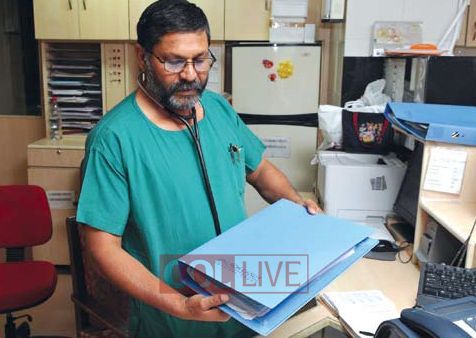
India – No one looking for the director of the intensive care unit at Mumbai’s prestigious Breach Candy Hospital would expect to encounter a bearded fellow with a black yarmulke on his head and tzitzis peeking out from his green surgical gown. No, he’s not from Israel, though he’s visited five times.
He’s not even Jewish, though he meticulously observes even the most minor halachos as though they were major. He’s even a leader of the local Jewish community.
For years, Dr. Aaron Abraham; his wife, Malka; and his children, Shmuel, Sarah, and Sharon have meticulously observed all the mitzvos, including the halachah requiring them to turn a light on or off several minutes before the end of Shabbos, since a non-Jew who observes Shabbos incurs the death penalty. In fact, Abraham’s children have never known anything but a Torah way of life. Only as they grew up did they understand that they themselves were not yet Jewish.
Dr. Abraham fell into the media spotlight after the terrorist attack at the Chabad House in Mumbai last December, when he stood guard over the murdered Jewish bodies of Gavriel and Rivka Holtzberg, Benzion Kruman, Rav Aryeh, Leibish Teitelbaum, Yocheved Orpaz, and Norma Shwartzblatt-Rabinowitz. For two-and-a-half days, he stayed in the morgue of the government hospital.
“I knew that if I neglected the bodies for even a moment, they’d immediately be autopsied,” Dr. Abraham told Mishpacha.
But those who heard of Dr. Abraham’s heroism after the massacre had no idea of the Abraham family’s daily heroism in observing mitzvos in India. very Shabbos the Abrahams walk to shul for Kabbalas Shabbos and Maariv, Shacharis, and Minchah — an hour each way.
Their kitchen is strictly kosher, and the children attend regular Indian schools (the local Jewish school is defunct) dressed in their Jewish garb.
Shmuel wears his yarmulke on and his tzitzis out and finds himself explaining to his friends why he and his father dress that way.
The Abrahams took care of us from the moment we met them in shul on our visit to Mumbai to the moment we left the country.
Arriving at their home, however, was an adventure in itself, an unforgettable tour of the teeming, filthy Mumbai streets. On the steps outside the building — and remember, this is a typical “middle-class neighborhood” — locals congregate on mats and discarded cardboard, preparing their lunch. In India, “street life” has a different connotation. It’s literally where people live. A piece of cardboard marks floorspace — squatters’ rights. If they’re lucky, they’ll fashion a roof out of scraps of rusted metal. An entire family might sleep here, side by side, on old moldy mattresses. And in the gutter alongside runs an open sewer, which is just as well, as the municipality has no way of controlling all that generated garbage.
The doctor’s home — the home of a top physician in a prestigious private hospital — is nothing more than a kitchenette, a bathroom I’d rather not describe, and one other room that serves as a family/dining room by day and a bedroom for the whole family at night. There is also a closet, a desk, and a computer, but the bare cement floors and the black, cracked walls on both the inside and outside of the building make everything seem gray. In Mumbai, the slums seem to pop up everywhere, wedged into the space between the buildings of the middle class, and even alongside the fanciest homes of Mumbai’s millionaires.
As we flew back to Israel, Dr. Abraham flew to Belgium for a medical conference, where he lectured his colleagues in his yarmulke and protruding tzitzis. In snatches of conversation during our stay and late at night in his hospital office between patients, Dr. Abraham sits with us and tells us his astounding story. “This isn’t a regular ward, it’s intensive care,” he apologizes periodically as he leaves us to attend to the most urgent cases.
Breaking With Tradition
Aaron Abraham was born in India as Bahagirdas Pradas. His father was the chief priest in the idolatrous shrine in his area. “My father believed in idols,” relates Dr. Abraham. “He worshipped them and prostrated before them, placed food before them, and claimed to have conversed with them.
“He worshipped them and prostrated before them, placed food before them, and claimed to have conversed with them. There were all kinds of bizarre figurines to which he attributed special powers. Even as a youngster, I didn’t understand how my father honored something I could smash with one swing of a hammer. I didn’t understand why my mother bothered to prepare food for these idols. Initially I attributed my confusion to my youth. But the older I got, the less I understood, and I realized that I could never believe in this. My father taught us how to pray to this wood and stone, but I never did. As the oldest child in the family, I was expected to follow in my father’s footsteps, but as time passed, the clearer it became to me that I wouldn’t.”
When Pradas completed his compulsory studies, he and his father began arguing openly. “I told him something like ‘They have a mouth but don’t speak, ears but don’t hear, eyes but don’t see. I didn’t yet know the verse in Tehillim. I’m the one eating the food you place before them. How can you believe in this nonsense?’ My father listened and remained silent. He had no answers.
“I couldn’t bear my father’s belief in this foolishness. I knew I would go my own way, but he’d waste the rest of his life on this nothingness. I wanted to show him these gods were worthless. So one day I entered his shrine, hammer in hand, and smashed the idols. Of course, he screamed at me.
‘The gods are angry!’ I retorted.
‘So let them do something; let them rebuild themselves.
I’m provoking them to do something,’ I said, breaking another idol.
Only later did I learn about Avraham Avinu and the Midrash about how he’d smashed Terach’s idols. Had I known,” Abraham says with a smile, “maybe I would also have placed the hammer in the biggest god’s hand and claimed that he’d destroyed his fellow god. But I didn’t know the Midrash.”
Bitter and angry, young Pradas left his village and went to study medicine at the University of Mumbai. But even during his studies, he kept searching for the true faith, wondering to whom to worship and who created the world.
“I looked at the complexity of the world. During my medical studies, I came to realize the astounding precision in the design of the human body, and how even the most sophisticated machine can’t compete with the intricacies of the human creation.
I said to myself, ‘Someone must have created this; it didn’t just come about. Such a wondrous world must have been created by a central power — I must find it.’
And thus I embarked on my spiritual journey.
Read on in the magazine pages below.



This is one amazing article!!!
wow a real ger tzedek!
WOW
AMAZING
Unreal! Heartwarming. May hashem watch his children and get nachas.
I want to cry, reading about this incredible person. I am humbled. If only non frum Jews could read this & comprehend the depth of this man’s soul, surely every one would return to grasp their inheritance that is theirs by right.