
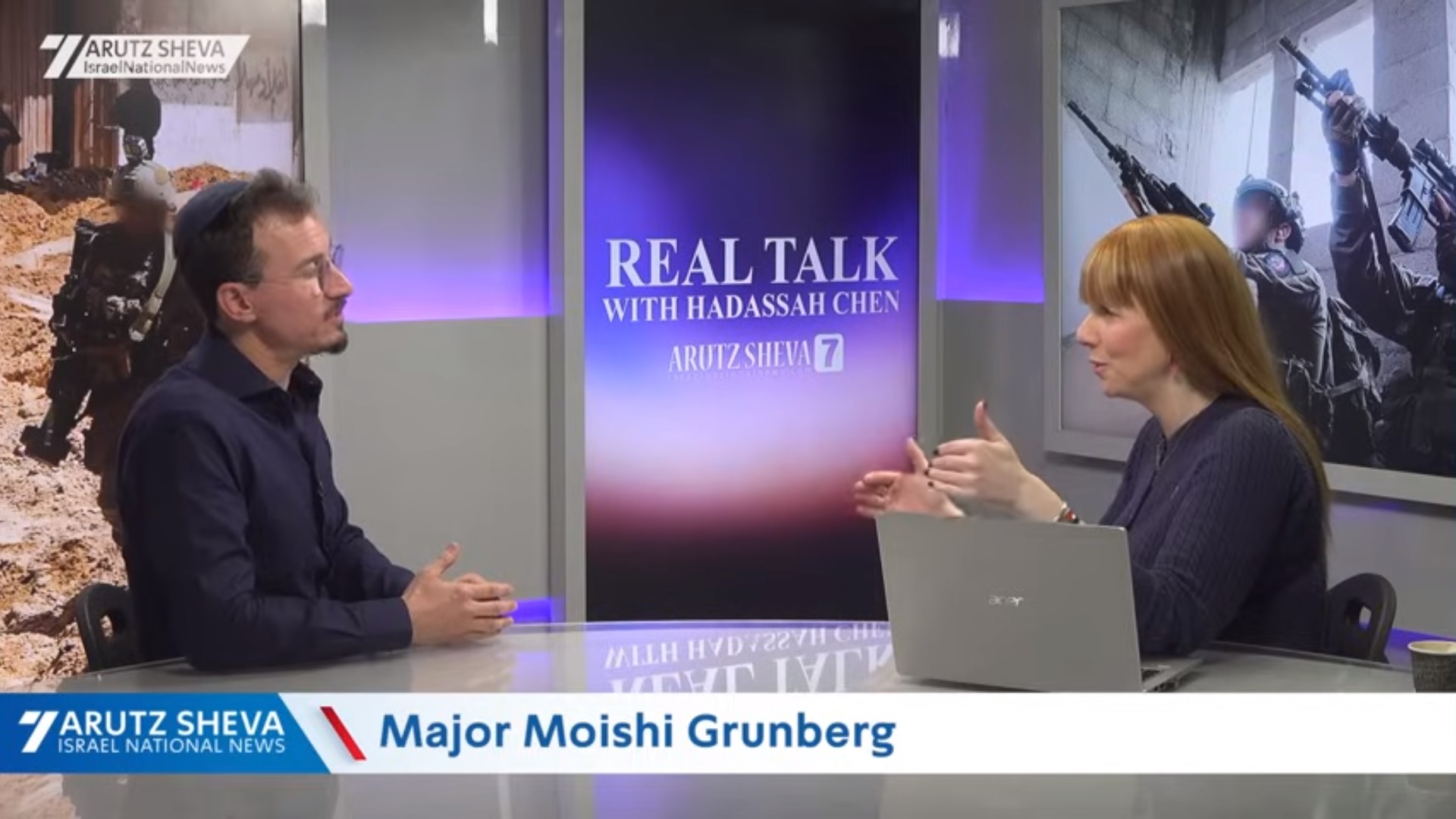
IDF Major Moishi Grunberg, an officer in the Combat Engineering Battalion, spoke to Arutz Sheva-Israel National News about his experiences fighting the war in Gaza.
“On Simchat Torah (October 7), I found myself in Kfar Chabad by my in-laws,” Major Grunberg explained. “I went to sleep 2:30 in the morning, and I was drunk. The next thing I know, my mother-in-law is knocking on the door, and she’s like, ‘Moishi, Devori – my wife – wake up, wake up, there’s sirens!’ And I hear the sirens, and it’s 6:30, 6:35.”
He recounted that he initially thought the alarms were the result of a malfunction, possibly due to the holiday, until they saw the rockets being intercepted by the Iron Dome missile defense system.
“We ran to the bomb shelter. I opened up my phone, and I saw the first video footage of what’s going on in Sderot and the Gaza [periphery] settlements. I knew, this is it.”
He serves in the tank corps of the 14th Division. Later that morning, he was contacted by his superiors, who told him to go with the rest of his force to Kibbutz Tze’elim, a small town about 20 miles south of Gaza.
“The first week, we were assisting with all the bodies, all the bodies of our brothers and sisters and the fallen soldiers in the kibbutzim. We were cleaning out the kibbutzim and cleaning out all the cars. Because as combat engineers, we had all the equipment to do so,” he said.
His division then received its orders to go into Beit Hanoun in northern Gaza, though the IDF would not launch a ground operation in Gaza for several more weeks, time that would be spent training and preparing for ground combat in Gaza.
Grunberg noted that Beit Hanoun was of key strategic importance because it is the highest part of the Gaza Strip by elevation. “It’s located in a very strategic position. You’re able to see with your naked eye in Beit Hanoun the Rutenberg electricity plant on the sea, you’re able to see the outskirts of Ashkelon, Kibbutz Erez, the new neighborhoods of Sderot.”
“You’re able to see the Israeli villages” from Beit Hanoun, he said. “And they’re just there. And you realize how easy it was for them just to cross the fence. And everything we’ve built up over the years, all these defense systems, just crashed.”
He called the amount of ammunition they found in Beit Hanoun “mind-boggling.”
“In every home, I’m talking about the outskirts, we found motorcycles that were part of the invasion on the 7th of October. We found cars,” he said, noting that these were not found in the homes of Hamas members, but in the homes of ordinary Gazans. “In every other home, practically speaking, there’s ammunition, Kalashnikov, Dragunov – the sniper guns. We found grenades, thousands of grenades, side bombs, booby traps; everywhere.”
He described the extent of the terror tunnel network constructed just in Beit Hanoun. “We found tunnels under kids’ beds. We found tunnels underneath schools, [such as] the UNRWA school in Beit Hanoun. We found tunnels underneath mosques. Terrorist infrastructure everywhere.”
“We found Mein Kampf books,” he added. “If we talk about what they’re standing up for, the Hamas, it’s not just anti-Zionist, it’s not just anti-Israel; we’re talking about anti-Jews. This is antisemitism in the most pure way.”
“This what they’re taught at such a young age,” he said.
VIDEO:



Kol.hakavod to moishi
May Hashem continue to keep you and all of the righteous IDF members safe and victorious.
Amazing story!
Great job
Giving back gaza with beit hanoun overlooking israeli cities was insane! Unbelievable the danger israel created by leaving gaza in 2005!
Didnt realize israel didnt invade gaza right away was because soldiers had to be trained
Great interview, thank you for posting