
By COLlive reporter
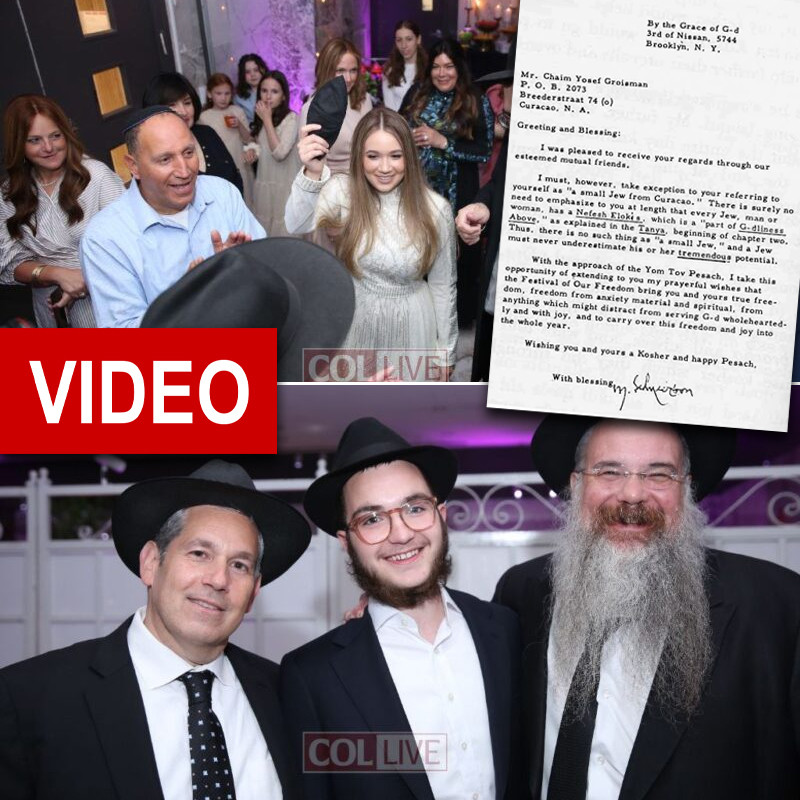
In a remarkable tale of providence and redemption, the story of “A Jew in Curacao” about a life taking a transformative turn thanks to the Rebbe received an added development altering the course of the family’s destiny forever.
Eli Groisman told the following story about his life:
I grew up in Curacao, a Caribbean island that is part of the Netherlands Antilles. There were no Jewish schools on the island at the time, and I attended a Protestant school.
I had a very difficult time at school. Although I was brought up in a non-observant household, I stubbornly refused to participate in the religious services and classes that were part of the school curriculum. Non-Jewish students picked daily fights with me, and I even felt that my teachers and the school’s principal were taking their side.
When I reached 7th grade, things were coming to a head. Life was not getting easier. On the contrary, fights were more prevalent than ever and more vicious. My relations with the school principal became more and more hostile. I started skipping school. I spent my days playing golf at the nearby golf club, returning to the school grounds in time to meet my father Chaim Groisman, who drove me home every day.
One day, the principal called my father into his office to find out why I had not been in school the past few weeks. Meeting me as usual that day after school hours, my father asked, “How was school today?” I replied, “The same as always.” My father then asked me, “Did you go to school today? Last week? Two weeks ago?” Not wanting to lie, I admitted that I had not.
My father gave me a choice: either give in and do as all the other boys do, or leave school and go to work with him — and work hard — every day. I didn’t need to think long. I walked into the principal’s office, put my textbooks on the principal’s desk, and ran back out to my father.
Warning letters started to arrive at our home stating the law that all minors must attend school. My family’s relations with the community also began to sour as a result.
My father was terribly upset about my situation, but he didn’t know any way out. One night he had a dream. He saw himself near the age of three, before his upshernish, sitting on his grandmother’s lap. She was saying to him, “Liuvu (Russian for ‘my love’), anytime you are in trouble, the one who can help you is the Lubavitcher Rebbe.” This was the first time he had ever heard of the Rebbe.
The next morning my father went to his shul, a small, unobtrusive building near his home. He asked the caretaker to unlock the door for him and went over to the Aron HaKodesh (ark), poured his heart to G‑d, and turned to leave.
On a January day in 1983, Rabbi Moshe Kotlarsky, assistant to Rabbi Chaim Mordechai Hodakov, the Rebbe’s senior secretary, received a telephone call at home from Rabbi Hodakov. “Wash your hands,” instructed Rabbi Hodakov, using a code term clueing in Rabbi Kotlarsky that the Rebbe was on the line, listening. “The Rebbe wants you to go to Curacao immediately.”
When the Rebbe tells a chassid to act, he does not ask questions; he acts. Rabbi Kotlarsky chose a traveling companion, Levi Krinsky, a 17-year-old yeshivah student, and both took the next flight to Curacao. Arriving at the airport and not knowing where to go or what to do there, they hailed a taxi, requesting to be taken to the synagogue.
Taxi drivers in Curacao are used to such requests, and they usually comply by driving to the largest synagogue on the island, renowned as the oldest synagogue in the Western Hemisphere, Mikvah Israel Emanuel. This synagogue, in which services are conducted only on Shabbat, also functions as a museum throughout the week. It boasts a unique feature: the floor is covered with white sand, possibly because its founders, who escaped the Inquisition, covered the steps leading to their houses of prayer in Portugal with sand in order to hide the sound of their footsteps.
This taxi driver, however, took Rabbi Kotlarsky not to Mikvah Israel Emanuel but to a small neighborhood shul. As the taxi pulled up to the door, Rabbi Kotlarsky saw a man leaving the building. Thinking that this man would be a convenient source of information about the local Jewish community, he approached him and said: “We were sent here by the Lubavitcher Rebbe. We want to get to know the Jewish people here. We are staying at the Plaza Hotel. Can you come with us and tell us about the local community?” The man, who was none other than my father, just walking out of the shul, nearly fainted.
My father told Rabbi Kotlarsky about our family’s plight and introduced me to him. My first question to Rabbi Kotlarsky was: “Are you allowed to defend yourself if someone comes up and punches you?” I had formed an impression from the movies and TV shows I had seen about the Holocaust that Jews were weak and did not fight back when attacked. Rabbi Kotlarsky responded, “You make sure that you defend yourself and do such damage that they won’t come back to you!” I thought this Rabbi was cool.
Rabbi Kotlarsky invited me to go to New York and attend Camp Gan Israel in the Catskills that summer and later to Yeshivah, which started in September. This was the answer to my prayers, and I accepted the offer immediately.
I would like to thank the Rebbe for caring for me and my family. We should all take his example on how one should care for a fellow Jew. It doesn’t have to be a Jew in far-off Curacao; it could be someone right around the corner. Surely, by following the Rebbe’s example, we will all merit the revelation of Moshiach.
Postscript 1:
A few years after meeting with Chabad emissaries personally dispatched by the Rebbe, the Groisman family moved to Caracas, where Chaim Groisman became a part of the Chabad community.
Chaim Groisman frequently served as a chazzan (cantor) in the local synagogue and studied with students at the local yeshiva, where he served as menahel Rashmi (secular administrator) of Chabad-Lubavitch schools. He passed in 2015 at the age of 74. He was survived by his wife, children and grandchildren.
Postscript 2:
VIDEO:
On Wednesday, renowned speaker Rabbi Shais Taub was one of the featured speakers at the Gimmel Tammuz Farbrengen of Chabad of the Five Towns in Cedarhurst, NY.
Chabad of the Five Towns is directed by Shluchim Rabbi Zalman Wolowik and his wife Chani, Rabbi Kotlarsky’s daughter. A few years ago, the Wolowiks hired Rabbi Taub as a scholar-in-residence.
Over the years, Rabbi Taub has delivered Torah lectures and classes to audiences on six continents, as well we writing columns and sermons. The story about “A Jew in Curacao” is one that he shared more than once.
But now, he revealed, it had personal meaning to him.
Earlier this week, Rabbi Taub’s son Yisroel Taub got engaged to Malky Groisman, who is the daughter of Eli Groisman and the granddaughter of Chaim Groisman.
The Kallah, Malky – Malka Bayla, is named after the grandmother who came to Chaim Groisman in a dream, telling him if he is ever in trouble, the one who can help is the Lubavitcher Rebbe…
As Rabbi Taub told the story at the Farbrengen, he became very emotional.
“The Rebbe, in his infinite view, waking up Rabbi Kotlarsky in the middle of the night, was thinking way beyond what happened in 1983 and way beyond whatever we know about in 2023 because this story is just getting started.
“If you ask, ‘What is our connection to the Rebbe on his 29th yartzeit.’ 29 years is a very long time. There are people who were born, grew up and got married, and started families of their own all in the past 29 years.
“So how fresh and up-to-date can our relationship be with the Rebbe? So I’m telling you about a miracle that the Rebbe just did for me that I just found out 2 nights ago. Everyone in this room is the recipient of miracles of the Lubavitcher Rebbe – whether they know it or not.”
As we commemorate the 29th yartzeit of the Rebbe, the impact of his divine guidance continues to reverberate through the lives of individuals around the world.
The story of Eli Groisman, now intertwined with the renowned speaker Rabbi Shais Taub and their newly forged connection, serves as a testament to the Rebbe’s unwavering love for every Jew. And a reminder that a Shlichus that was once given (to Rabbi Kotlarsky) continues to have results (through his daughter and son-in-law).
As we strive to emulate his example of care and compassion, we anticipate the future unfoldment of miracles yet to come, forever inspired by the indelible mark left by the Rebbe on our world.




This is an incredible story. Thank you COLlive and Rabbi Taub, for sharing.
אשרינו מה טוב חלקינו
R. Sholom Ber Shuchat in the picture grew up with Chaim Grosiman z”l in Caracas, Venezuela. We all davened in the same Yeshiva Guedola in S. Bernardino.
A small world – A big Aibishter running it !
I just finished seeing this clip / Farbrengan with Rabbi Taub.
The incredible unfolding story is an amazement within itself. Your Emotions and realism as you relate this story make it all the more touching and alive.
What a Zechus to marry into such a special family. Mazal Tov.
A long story with twists and turns that has such a happy ending (or beginning )
Thanks