

With seventeen children scattered across a dozen time zones, the famous Greenberg family is a global phenomenon, bringing Torah and mitzvos to Jews at the furthest corners of the earth — including Alaska and China, Vancouver and El Paso, Odessa and Germany, Paris and Rehovot, to mention a few of the cities they call home. Mishpacha speaks to the Greenbergs about their upbringing, the unusual people and places they’ve seen, and the clever ways they’ve devised to retain a strong sense of family togetherness
by Barbara Bensoussan
When Moshe Greenberg was sentenced to twenty-five years of hard labor in a Siberian prison in 1951, he thought his life was over. Originally from Romania, he had fled from the Nazis, to Russia and later to Tashkent. Having come from a religious home, he sought out a “yeshivah,” which in that time and place meant a clandestine Lubavitch chevrah that met in people’s homes.
When World War II ended, the “yeshivah” disbanded. Knowing that the Russians were giving permits to some Polish citizens to return to their homeland, many of the young men obtained false Polish papers and got on the train for the first leg of the journey from Tashkent to Czernowitz. But the train was stopped, and their papers confiscated.
Moshe tried a second time to get out of Russia, with a man who promised to smuggle him out with two other young men, and an older man. But the smuggler was an informer; when they got near the border, he shot his gun into the air, and they were all arrested. They were sent to Kiev for prosecution, and the verdict was brought down a year later: twenty-fi ve years’ punishment in Siberia.
In the end, the twenty-five years were commuted to only six and a half. Then, after Stalin died, the government revised some old cases, and decided that attempting to leave the country was an offense punishable only by three years in prison. Moshe Greenberg was released and made his way to Moscow, where he met and married his wife Devora.
The Nazis had sought to wipe out Moshe Greenberg physically. He escaped and fl ed to Russia, where the Soviets sought to wipe out his spiritual heritage. But if he who laughs last laughs best, then when Moshe Greenberg fi nishes his 120 years on this earth he will have good cause for belly laughs all the way to his celestial bank account. For he has triumphed, and wreaked the best vengeance imaginable on those who seek to destroy Jews and Torah: he and his wife went on to found a family of — bli ayin hara! — seventeen religious children, who have in turn given them so many grandchildren that it’s a wonder they don’t mix up the names (they don’t, say their children).
International Holdings
Moshe Greenberg didn’t start out in Lubavitch; he came from a chassidic family in Rumania. His wife also came from a religious, but not Lubavitch, home, in Odessa. “In Russia at the time, the only Jews who were still religious were the Lubavitchers,” explains their son, Rabbi Baruch Greenberg. “So those are the people my father learned with as a young man. And when my mother came to Moscow from Odessa, she also became affiliated with Lubavitch. As Baruch’s brother Zushe once wrote, the young Moshe Greenberg “never dreamed that in communist Russia he would find a Jewish girl who shared his religious beliefs, and was ready for the self-sacrifi ce necessary to raise an observant family ” but he did. After having their first six children, and unwilling to stay in a country that persecuted religious Jews, the Greenbergs left Moscow in 1966 with their six children, settling in Bnei Brak.
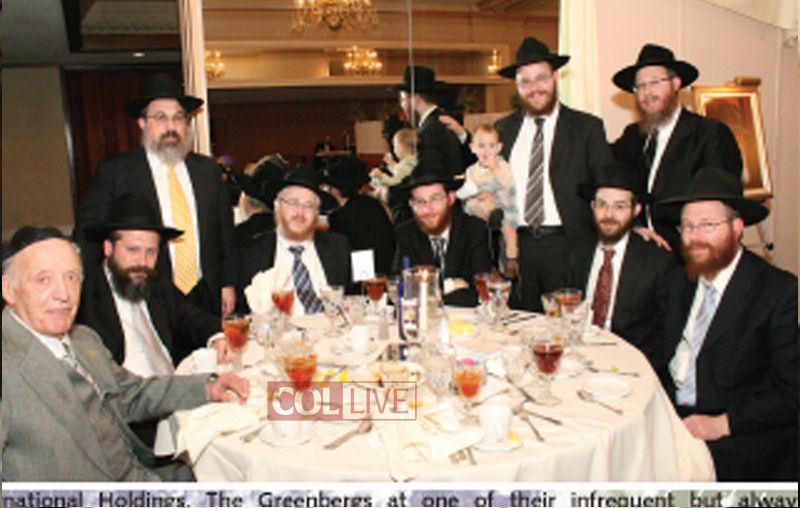
Today, the Greenbergs probably hold the record for the Chabad parents with the most, and most far-fl ung, shluchim among their children. To date, twelve of the seventeen work in shlichus. Several others are working in what might be termed “para-shlichus” activities (at the main offi ce in New York, and the education network). They are scattered across almost a dozen time zones, in Alaska and China, Vancouver and El Paso, Odessa and Germany, Paris and Rehovot. Others are in Austin, in Ohio, in the Detroit area, in San Diego, and Crown Heights. It is a rare Chabadnik who has not heard of the famous Greenberg family.
Constraints of time and space made it impossible to interview every member of the family. But we were able to speak to seven of them about their unique and inspiring family. They are a very energetic, upbeat group; the overwhelming impression is one of very happy, utterly normal people, absolutely thrilled to have grown up in such a large and active family.
How Did They Do It?
Rabbi Yisroel Greenberg, the third Greenberg son and the shaliach in El Paso for the past twenty-two years, asks rhetorically: “How is it that, out of seventeen kids, not a single one of us went into business? We all ended up as klei kodesh —rabbis or mashgichim or teachers.” One might well ask the question, since we live in an age when many families are struggling simply to keep children on the derech — let alone have them go into chinuch or kiruv — and often in much easier economic circumstances.
“We got it from my father,” Rabbi Yisroel says firmly. “When he came as a newcomer to Eretz Yisrael, he wasn’t coming to relax — he was coming to help.”
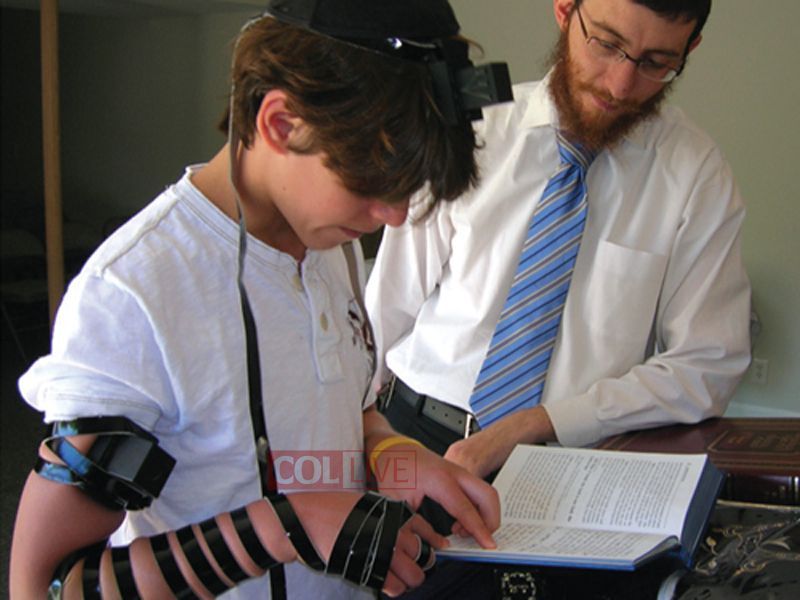
In 1968 [two years after his arrival], he went to New York to be with the Lubavitcher Rebbe. My father came back with a totally different energy; he began convincing all his nonreligious Russian friends to put on tefillin. He was working as a diamond cutter, but every Friday he would go to Petach Tikva to put tefi llin on people. At night, he would come home from work, eat something, and run out to put up mezuzos or to kasher kitchens in Tel Aviv and other nearby towns.”
“The Rebbe paid for that [1968] trip of the Russian Jews to New York,” remembers Rabbi Yosef Greenberg, currently a shaliach in Anchorage, Alaska. (He has to pause and think a minute before positioning himself in the family: “I think I’m number five … ”)
“The Rebbe paid special attention to them throughout that Tishrei, having them stand next to him during the shofar blowing and during Ne’ilah. They returned home very inspired. The Israelis in our neighborhood — we lived on the same street as Rabbi Greineman and near the Steipler — couldn’t get over them: Jews from Russia who were actually frum! You have to realize that at the time none of the Jews who came out of the Soviet Union were religious.”
A Houseful of Only Children
The Greenberg home developed into an informal Chabad House, with people often coming in and out; Rabbi Yisroel remembers that people would send letters to the Rebbe and receive their responses through his father. Their children were among the first in the Chabad cheder, and the family began the fi rst Chabad Center in Bnai Brak.
Rabbi Baruch Greenberg, who directs the Chabad House of Oceanside, California, has fond memories of those days. “I’m Number Fifteen,” he says, his voice refl ecting his relative youth. “I remember being three years old, and since our apartment was very small, the boys had to sleep in the dining room. We rarely went to sleep before ten or eleven o’clock at night, because there were always people coming into the house. Some of us slept in the entryway or the hallway.” His sister, Mrs. Bassi Shemtov (Number Eleven), concurs: “We kind of fell asleep whenever. There wasn’t a formal bedtime. It wasn’t strict, but it wasn’t too loose either.”
What comes across most strongly from the Greenberg children’s reminiscences is the tremendous love they received from their parents. Moshe and Devora’s children speak of their parents with immense admiration, as completely dedicated to their children, and completely dedicated to other people.
“They were a living example for us,” says Mrs. Shemtov. “The result is that I am following in their footsteps — I have ten children of my own, kein ayin hara! My parents never preached and they never complained; they were always happy and positive. When I went to a school in another town, one of my schoolmates exclaimed when she found out I had many siblings, ‘I thought you were an only child!’ But that was just it — they made each of us feel like an only child.”
“I remember that every single time I would come home, my mother was there,” says Rabbi Baruch. “Even today, whenever I come, she’s there with a pot of hot soup to serve me. I felt I had much more than other children; I got everything I needed, and I never knew what it was not to share. We got so much from the family that today we are able to share that love.
“We were raised with the concept that you must always be there for other Jews,” he says. “My father was constantly out helping people, and my mother made that possible by taking care of everything else at home. She deserves a lot of credit for assuming such a hefty burden of caring for the home.”
“My mother herself was the oldest of a large, frum family,” says Bassi Shemtov. “And she knew that eventually we would have large families and responsibilities of our own. So she didn’t want to overwhelm us. We helped a little, but not to the extent that we had to miss out on school activities or being with our friends. That said, my mother worked very, very hard. There were never any cleaning ladies, never any babysitters.”
As for material possessions, Mrs. Shemtov reminds us, “The gashmiyus was on a lower level then. In general, people didn’t have as much. We knew we couldn’t spend freely, but we got what we needed. For example, we never had a car; we used the buses. We didn’t go to sleepaway camp, but neither did anyone else in Israel at the time. We never felt like rachmanus cases.”
Her father put things into perspective for his children as follows: “After all the miracles [being released from Siberia, finding the perfect zivug, getting out of the USSR to go to Israel], I should worry about a few pieces of bread? If G-d gave me strength to survive all the hardships, surely He could give me the strength to provide for the needs of my family.
“We didn’t have much, but the result of that is today I’m happy with whatever I have,” says Rabbi Baruch. “It never seemed like a big deal, because we were all so proud and happy to be part of the Greenberg family.”
Fruits of their Labors
Today, the Greenberg family address book reads like a roll call of the United Nations. Perhaps the most exotic are the addresses of Rabbis Shalom and Avraham Greenberg, each of whom runs a Chabad house on opposite ends of Shanghai. When I called, it was a little unnerving to have my call answered by a Chinese secretary with an accent so thick that at first I thought she was speaking Chinese (even though I’d dialed “2 for English”). But everything in China is different, says Rabbi Shalom. “The more you know, the more you know that you don’t understand anything,” he says. “The only way to be successful is to admit that you can’t understand the Chinese mentality.”
He came to China ten years ago, in 1998, the first shaliach to come to mainland China. He and his wife had been married a little over a year.
“There were about 150 Jews here at the time,” he says. “From the US, from Australia, from Israel, and more. But there was nothing Jewish: no shul, no mikveh, no school, no restaurant, no grocery. The Jews who were here weren’t religious — after all, if they had been, they never would have come to such a midbar.”
Everything requires tremendous forethought and planning. “We start preparing for Pesach now, in November,” he says, “because we have to put together a container shipment of all the things we need. That requires permits from the Health Department, and all our documents have to be translated into Chinese.” But the government has not harassed them, Shalom says, “because we’re very good for business.”
Since arriving in Shanghai, Rabbi Shalom and his wife have had four children who, he says, “speak better Chinese than I do.” They attend the preschool, which has about twenty children, as well as the 45-pupil Hebrew school. But much of their education happens on-line; Chabad has an extensive, comprehensive on-line education program, in Hebrew and in English for the children of all their shluchim worldwide, children who are living far from any yeshivah or regular school. (The Greenberg families know all about this, because their sister Chava Kastel in Rehovot directs the Israeli-European Online School for Shluchim).
China is certainly an exotic locale and a Jewish midbar, but Yosef Greenberg and his wife set themselves down in what it quite literally a wasteland by any standards, Jewish or otherwise: he became a shaliach in Alaska. “My father joked, ‘First they sent me to Siberia, now they’re sending you to Alaska!’” Rabbi Yosef laughs. “Well, we arrived in 1991, the day before Purim, and we’ve been here ever since.”
They have not been idle for the past seventeen years. They got a shul and a mikveh up and running. They’ve run Chanukah celebrations, attended by 1,000 people. At present, Rabbi Greenberg is busy constructing a $5 million, two-and-a-half acre campus that is to include a preschool, a talmud Torah, and a museum. When I called, he was busy with the fi nal stages of organizing his fi fth annual fundraising dinner and auction, a gala event that will include Governor Sarah Palin’s parents (Governor Palin herself will be out of town) and the lieutenant governor. The dinner will honor Warren Metzger, a non-Jewish pilot for Alaska Airlines who flew many Jews from Yemen to Israel.
“Israel needed a company that didn’t have regular fl ights, only charters,” explains Rabbi Yosef. “Alaska Airlines fit the bill, and was hired by the Joint. They did 390 fl ights and brought between forty and fi fty thousand Jews to Israel. Mr. Metzger even married his wife during one of his stopovers.
”Working with his congregants never fails to bring surprises. One man, a prominent lawyer, decided to research his family roots. He went to the tiny town in Russia that his family had come from, but all he found was “a sort of ‘Jewish shrine’” that actually looked as if it had been tended — as if some Americans had been there and kept it up. “When he asked me to translate the writing on the matzeivah, I saw that it was the gravesite of my great-great-grandfather, the father of the Ruzhiner rebbe!” Rabbi Yosef says. So in an interesting twist of fate, “Today I am this man’s rabbi, just as his ancestors probably had my great-great-grandfather as their rabbi.”
In another instance, a non-observant family asked Rabbi Yosef to help make a bar mitzvah for their twelve-year-old, because the boy’s grandmother was pushing hard for it. “He had almost no background,” Rabbi Yosef says. “But we did our best. Then, at the bar mitzvah luncheon, the grandmother got up to speak. She said: ‘The reason this was so important to me is that I was born in a religious town, a place called Berditchev. Of course, between the Revolution and the War, we had to leave, and our Yiddishkeit was completely disrupted. But I do know that my family is descended from some kind of tzaddik — I believe he was called the Baal Shem Tov … Maybe you have heard of him?’”
If you now fly south, way south from Alaska all the way to the US-Mexican border, you will come to El Paso. “It’s really isolated down here,” says Rabbi Yisroel. “We’re a two-hour fl ight from Houston,” he adds. “There’s an army base, and people who like living close to the border for various reasons.”
He had to create a Chabad House and a mikveh, which is a story unto itself. “People here were so ignorant that they said, ‘What do you need a mikveh for? For once a year before the holidays?’ And there were practical reasons for discouraging us; they said, ‘You’ll never get enough rain down here to make a kosher mikveh.’ Well, in the summer of 1988, my wife and I were in Crown Heights, and she asked the Rebbe specifically for a brachah for rain. We returned home, and about a month later, we had a rainstorm the likes of which no one had ever seen in El Paso! It rained for four straight hours! Baruch Hashem, it was enough to fill up the reservoir of the mikveh and make it kosher for use.”
Rabbi Yisroel cites the advantages of working in a small community: everybody has to be involved; nobody falls through the cracks. “Each Jew really counts in a small community.” The only problem is the lack of yeshivas; when his congregants become more religious, they tend to move away to be able to obtain higher-level Torah chinuch for their children. Rabbi Yisroel admits that this is the most valid reason to leave, although it would be nice to keep more frum people down in El Paso to eventually build up a real community.“
My success is my problem,” he laughs.
Venturing into the most obscure places, the towns in which everybody is sure there are no Jews, turns up many a surprise. Rabbi Shneur Greenberg, who has set up shop in Commerce, Michigan, recounts that when he first arrived in 2002 they set about celebrating the High Holidays in an apartment building. On Rosh HaShanah they managed to gather nine men and still needed a “tzenter.” One of the ladies who had come was a resident of the building, and offered to knock on the doors of a few people she knew to be Jewish. She eventually returned with “Barry,” an elderly man.
As the tefi llos progressed, Rabbi Shneur noticed that Barry was becoming very emotional. When the minyan finished, he approaced him, and gently opened a conversation. Barry told him, “During the war, the Nazis came to our little shtetl in Ukraine. They gathered all the Jews, fenced us in with barbed wire, and began shooting. My mother was a small lady with a big personality. She somehow managed to create a little hole in the barbed wire, large enough for me to squeeze through, and she told me, ‘Baruch, run and take nekamah [revenge]!’ I never saw my family again.”
After that, Barry/Baruch could not bring himself to face a Rosh HaShanah service — that is, until Rabbi Shneur came to Commerce and pulled yet another Jewish neshamah out of hiding.
Keeping It Together
How do you maintain close family ties when your family is spread out across a dozen time zones?
“We do a family e-mail once a week,” explains Rabbi Baruch. “My sister Chava in Rehovot takes care of it. For my parents’ birthday, one of my brothers arranges a big conference call. It takes a couple of hours, and one by one, we all get a turn to speak.
“Most of us come every year to the kinus of shluchim in Crown Heights, unless somebody’s having a baby or there’s some other commitment. We all squeeze into my sister Bassi’s apartment and talk till all hours. Then a lot of us also come in for Gimmel Tammuz [the Rebbe’s yahrtzeit].”
He tells me that one of the Greenberg grandchildren, as a gift to the grandparents, made a calendar in which every family member’s birthday is marked. “It’s basically full!” Rabbi Baruch jokes. “And now my siblings call me for my children’s birthdays, before I even realize it myself!”
I asked Rabbi Shmuel Greenberg, the thirteenth child, currently running the Chabad House of Vancouver, Washington (“not Vancouver British Columbia,” he clarifi es — “We say it’s Washington but not D.C., and Vancouver but not B.C.!”), if he missed getting to know his older siblings, because so many of them were out of the house during the years he was growing up. “Well, they were in and out,” he says. “We would see each other at kinuses and for simchas. But today, as an adult, I know the older ones better than I did as a child.”
Of course, those who suffer the most from the family’s dispersion are the Greenberg parents. “The family separation is the biggest mesirus nefesh for my parents,” states Rabbi Yisroel. “But they have never complained. They always encouraged us to go out and do our work. I really give them credit.”
When pushed, matriarch Devora Greenberg admits, “Yes, it’s very hard. Twelve of my children are shluchim, and only four are living in Eretz Yisrael. But we talk on the phone often, and we get together for simchas.” For example, the family recently got together for the wedding of the second Greenberg grandchild, in El Paso, Texas; eleven of the seventeen siblings made it in. It was the first chassidic wedding in El Paso ever — and what a wedding it must have been!
Perhaps the amazing thing is how well they all do keep in touch despite the distances, how connected they nevertheless seem to be. Their common dedication to the goal of Jewish chinuch unites them even more strongly, as siblings become not only siblings but colleagues and resources as well.
Reflecting on the Greenberg family’s accomplishments and apparent state of constant good cheer brings to mind a quote from psychiatrist and Holocaust survivor Dr. Victor Frankl: “Success, like happiness, cannot be pursued; it must ensue. . as the unintended side effect of one’s personal dedication to a cause greater than oneself.”
In consecrating themselves entirely to the chinuch of their children and their community, Moshe and Devora have created, despite all the odds, success and happiness both for their children and themselves.
THE GREENBERG MACHZOR
When, as a twenty-year-old bochur Rabbi Moshe Greenberg landed in prison in Siberia, he worried that the summer would end and he would not have a machzor with which to pray during Rosh HaShanah and Yom Kippur. He was not the only one; they were a group of about twenty Jews amid a thousand inmates.
Suspecting that a certain engineer, who came in from outside the camp for various projects, might be Jewish, he waited for an opportunity to approach the engineer. “Kenst du mir efshir helfen? Can you help me? Could you bring a machzor to me?
“The man eventually got back to him and said that his girlfriend’s father had a machzor, but refused to lend it out. Reb Moshe offered to copy the whole thing before Rosh HaShanah and give it back, if the man could just bring it in. Finally the owner agreed, and at great risk to himself the engineer smuggled in the machzor.
Rabbi Greenberg built a large wooden box and hid in it for a few hours every day, laboriously copying the text of the machzor by hand. There was only one page missing: Kol Nidrei.
The holidays arrived, and after bribing the guards to let them gather for services, the Jewish inmates prayed from Rabbi Moshe’s handwritten machzor. But on Yom Kippur, not one of them could remember Kol Nidrei by heart. They did the best they could, which was more than good: years later, Rabbi Moshe would say that he had never experienced such meaningful davening.
When Moshe Greenberg was released from prison, the machzor was the only item he took with him. He took it with him when he made aliyah, and he took it with him on a visit to the Lubavitcher Rebbe in 1993, where he presented it as a gift to the Rebbe. It remains in the Rebbe’s library, as a testimony to Jewish devotion and determination.
Fast forward to the present, where Rabbi Greenberg’s son Zushe runs a Chabad House in Solon, Ohio. He was so deeply moved by his father’s machzor that he had it copied on a copying machine, and uses his personal copy to lead Yamim Noraim services in Ohio. But the Kol Nidrei page is still missing. Rabbi Zushe writes that at Yom Kippur he asks his congregation, “and indeed all of us, to say Kol Nidrei for him [his father] and anyone else who may not have the opportunity to do so.”




“I cant believe this is Mishpacha? Isnt this the same magazine that published an article only a few months ago, saying that Lubavitchers are crazy and everyone should daven for us?!”. UGH!
people can changed….
especially when it comes with a good story for sale…
I cant believe this is Mishpacha? Isnt this the same magazine that published an article only a few months ago, saying that Lubavitchers are crazy and everyone should daven for us?!
That story about the machzor, unbelievable! I had tears in my eyes. Such mesiras nefesh. The family should have a lot of hatzlacha in gashmius and ruchnius.
Such a kiddush lubavitch. what an amazing family.