
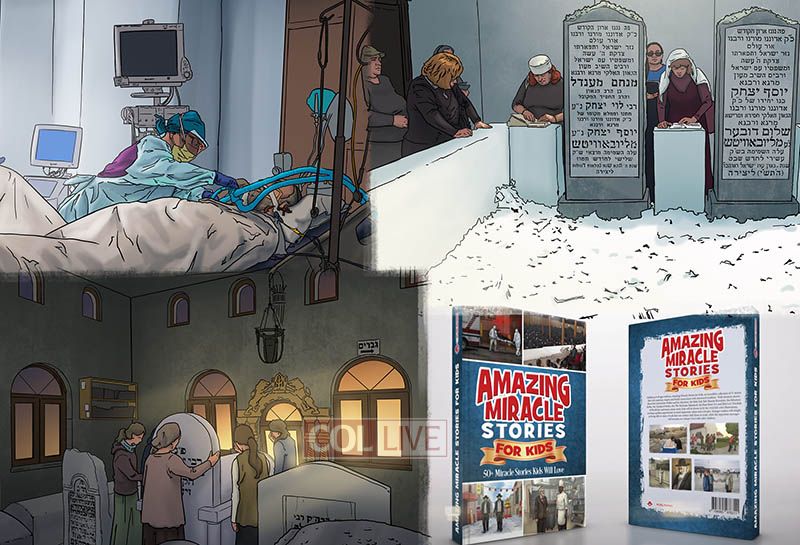
A story originally seen on COLLive, My Promise At the Ohel Saved My Husband’s Life is now found with further details in a new book filled with stories of the Rebbe and other tzaddikim.
—
My name is Shabtai Weintraub. I want to share with you a miraculous story. I heard this story firsthand from Rabbi Tzvika Gottesman and his wife. I met Rabbi Gottesman early one morning in shul. It was the 17th of Kislev; I was getting ready to daven at a shul in Nachalat Har Chabad in Kiryat Malachi, Israel. Minutes before shacharis, Rabbi Tzvika Gottesman came over to me asking to borrow a gartel.
“I don’t have one because I’m not chassidish,” he told me. “But the button on my jacket just broke, and I’d like a gartel to help keep it closed during davening.”
I could see a short string where a button used to be and the bottom of R’ Gottesman’s jacket hanging open. So, of course, I agreed to help him find one and started asking around, trying to find someone who had an extra one for him to borrow. A few minutes later, R’ Gottesman tied a borrowed gartel around his waist.
“You know,” I said. “Tomorrow night, the 19th of Kislev is Chag HaGeula. It’s the day the Alter Rebbe was released from a Russian prison. So maybe this is a sign that you should start wearing a gartel in his honor.”
R’ Gottesman widened his eyes and looked at me in shock. It was as if I had discovered a deep secret of his. I was not sure what I had said to spark such a reaction. He didn’t say anything, but I could tell he wanted to. The thought stayed with me all davening. What could this stranger be hiding?
After shacharis, R’ Gottesman called me over and asked to speak in a small room next to the shul. He still looked a little shaken. We closed the door to the room and sat down.
“I have a very deep connection to the Alter Rebbe,” he said. “He saved my life!”
This time it was my turn to open my eyes in surprise. It wasn’t that I didn’t believe him, but how could the Alter Rebbe have saved a man’s life if he passed away so many years ago? I had to hear more.
“It was exactly one year ago today,” R’ Gottesman explained. “I was in a coma. I was stuck in a hospital in New York, sick with corona and days from dying. The fact that I am alive today is a miracle! My doctors couldn’t believe it when I woke up. I don’t know much of what went on, but my wife went to daven at the Ohel of the Lubavitcher Rebbe. She cried to the Rebbe telling him I hadn’t finished my duty here in Olam Hazeh. If I hadn’t learned Tanya yet, there was still much more for me to do in this world. I woke up less than two days later, on the 19th of Kislev; famously known as the Yahrzeit of the Maggid of Mezritch and also for the day on which the Alter Rebbe was released from jail.”
“Your wife went to the Ohel of the Lubavitcher Rebbe and then you woke up on the day the Alter Rebbe was released from prison?” I asked.
Rabbi Gottesman nodded. “I still don’t learn Tanya in the correct order,” he admitted. “But I make sure to learn every day. I have kept my wife’s promise to the Rebbe. I go to a Tanya class in Elad where I live.”
For a long while after speaking to this man, Reb Gottesman’s story stayed on my mind. I felt something special had sent him to me and it was a story waiting to be told. I regretted not asking for his number or getting the chance to hear more of what happened from his wife. I knew his story was powerful. The look on his face alone spoke worlds, and there seemed to be a lot more to say still.
But, luckily, or more likely as a result of hashgacha pratis, I found the Tanya shiur Rabbi Gottesman went to regularly and realized I knew some people there. I called around and eventually found myself on the phone with his wife. She told me this story with more details:
“My husband left Israel on a flight to America in Elul 5780 or August in 2020. This was just months after the coronavirus became famous and did damage worldwide. He worked with a tzedakah organization n in New York giving out food to poor families for shabbos. He hadn’t been to America since the virus broke out and knew it was time to go back. He planned to stay throughout Rosh Hashanah and Yom Kippur and come back to Israel just a day after the fast. But Erev Yom Kippur he started feeling not well, perhaps a little sick.
“My husband asked his Rav if he should fast and was told he should. The first sign that he was really sick was when he collapsed on Yom Kippur day. At first, we didn’t know what was wrong – maybe a tiny cough – but quickly, my husband started getting worse and couldn’t breathe normally. He went to a doctor and found out he had Covid. Over the next few days, he got sicker and sicker before eventually being taken to the hospital. I got a call from a doctor there telling me my husband was very ill. I was frightened. And the next thing I know, I’m being told my husband needs a breathing tube. It seemed so serious it was becoming life or death.”
“I was in Israel with the kids, trying to celebrate the chagim. I wanted to make them as nice as possible given everything that was happening. We were all terrified. But through the month of Tishrei, we prayed and did whatever we could. You can bet on Yom Kippur we poured our hearts out. We still didn’t let it take away our simchas Yom Tov still. We sang zemiros on shabbos and sat in the succah singing and hoping the simcha would bring bracha. Simcha can cause any heavenly decree to end. We knew my husband would want us to celebrate Hashem even in that tough time. Time passed, and Simchas Torah was over. My husband was still sick in New York in a hospital and unable to speak with us.”
A week after Succos, a doctor called to tell me there had been a change.
“Come to come to New York,” he said. “I think it’s time you say goodbye.”
“I didn’t understand at first. But the doctor’s voice grew serious. “Your husband is going to die.”
“I was stunned. This was my partner, my husband, and I hadn’t seen him in weeks. I didn’t have a VISA or any way to get to New York. I felt helpless. Who can help me? Who would help my husband? But I kept davening and begging Hashem to help me get to America. I went to Rav Kaniefsky and asked him to daven for us. He told me to add the name Chaim to my husband’s name. The Rav also told me to move apartments.
“Changing your surroundings can change your mazel,” he said.
“A few days later a Rav came to change my husband’s name officially, and we agreed to move the same day. My children and I were busy packing when I got a call from a successful businessman in America.
“I’ve arranged for you to come to New York without a Visa,” the man told me. “But you need to leave tonight.”
“I was overwhelmed. Everything felt like it was happening all at once. But I knew this was my chance to go be by my husband’s side and took the chance without thinking. After a long and emotional day, I ended up on an almost empty flight to the United States. In those times international flights, which went from one country to another had very few people, as there were so many rules with corona. Planes that usually had hundreds of people, were almost empty.
“After landing, I took a taxi and went straight to the hospital. It felt cold and unwelcoming. I never imagined I would be in America for my sick husband. I met with the doctors and sat by my husband’s side. The heartbeat monitor beat like music, reminding me my husband was still alive and kicking though he was in a coma which means he was deep asleep and not aware if anything happening around him. But, There was still hope. However, the doctors weren’t so encouraging.
“I’m sorry, Mrs. Gottesman,” one doctor said. “I don’t think your husband is going to make it a full week. Be prepared for him to pass before Saturday.”
“Hearing those words was the worst feeling in the world. I felt helpless and scared. For hours I cried by his side. I wasn’t ready to give up. My husband is Litvish, but I am from a Sanzer Chassidish home, so I knew I had somewhere to turn!
“Shabbos came and went, and on Sunday, my husband was still alive. He wasn’t doing much better, but the doctors were surprised his heart was still beating, giving me new faith
I asked to go to the Ohel of the Lubavitcher Rebbe. My chassidish upbringing showed me I could always go to the Rebbe and my spiritual home taught me that tzaddikim are forever there to support am yisrael. I spent hours crying and davening at the Ohel. I told the Rebbe that my husband hadn’t finished his purpose yet, that he still needed to learn Tanya. I dont know why I picked Tanya. I just felt my husband needed to learn Chassidus. I promised the Rebbe that I would make sure he learns Tanya if he saved my husband. I stayed in Ohel for hours with Tehillim.
The truth is I had nowhere else to go and no one else to ask for help. The Ohel wasn’t far from the hospital, and praying there made me feel safer. I stayed and promised to come back and thank the Rebbe when a positive change happened.
“As crazy as it sounds, my husband opened his eyes the very next day. For the first time in a long while, his eyes were open for a few moments! A part of me was scared we had reached the end – maybe he was dying, and this was his final moment. But he kept living. He didn’t come out of the coma just then, he obviously wasn’t cured, but he seemed to be doing better. It was a blessing! And I knew I had the Rebbe to thank.
“On Tuesday, only two days after my first visit, I was back at the Ohel. I walked into the tent and saw a video of the Rebbe playing on a big screen. He was giving a public sicha, but it was as if he was speaking right to me. I felt the words were talking to my heart. One line in particular truly spoke to me. I felt like I was being spoken to directly. The Rebbe said:
“In the merit of ruchnius, the decrees will be revoked.” Believing in Hashem and having spirituality can change the bad things from happening.”
“I knew at that moment that my davening and emunah didn’t go unanswered.”
“I spent the next month in the hospital by my husband’s side. He was getting better but still needed some time – his fever hadn’t gone down since Yom Kippur. I watched as doctors and nurses mixed up my husband’s medicine and charts. They were the people who were supposed to be taking care of him, but they were putting his life in more danger. It was a miracle he continued to grow stronger. It was proof that Hashem truly controls the world.
“I started to grow hopeful but the doctors kept pushing me down. “The medicine alone could kill him,” the head doctor told me. “When someone is this sick even treatment is risky.”
“I knew I needed to keep davening. But I couldn’t stay in New York forever, my children were waiting for me at home. With a tearful goodbye and one last visit to the Ohel, I let my brother-in-law take my place beside my husband. I went back to Israel and worked on supporting my children. My friends became my support, and after only a week in Israel, they had convinced me to go to Uman.
“We will make sure your children are safe,” they said. “Go daven at kivrei tzadikim. Go daven for your husband!”
“Feeling like my husband’s gezerah still wasn’t lifted, I made the hard decision to leave my children again. A close friend and I booked flights and flew to Uman. There we met a group of chassidim who promised to daven for my husband. They came with us to the Ba’al Shem Tov and on the 19th of Kislev – Chag HaGeula – the kever of Avraham HaMalach, the Alter Rebbe’s chavrusa. The chassidim danced and sang at the kevarim, promising to spread joy for my husband’s refuah shelaima.
“On that same day, while I was in Ukraine, on Chag HaGeula, 70 days after first falling into a coma, it happened. My husband mysteriously woke up. He seemed to be in excellent health. The doctors were shocked; they couldn’t understand how he had made such a miraculous recovery.
“It is miraculous,” they said. We certainly agreed, but for reasons, the doctors could not understand”
“A month later, on the yahrzeit of the Alter Rebbe the 24th of Teves, my husband was released from the hospital and was able to come home! My husband kept my promise to the Rebbe and now learns Tanya daily with the Chabad community in Elad, Israel. We have been extremely lucky, and truly see every day together as another nes.”
More importantly, we learned how tzaddikim are still with us, even decades after they’ve passed away. The Zohar says that Tzadikim live eternally. They don’t live by the food they eat alive – even long after they move on from this world, they are still connected to it in miraculous ways. They are forever here to help us and lead us. Not just from up in shmayim, but from right here on earth.
Amazing Miracle Stories for Kids is available on Amazon here.



Thanks to the Ribono shel Olam, HaKadosh Baruch Hu, who is the ultimate Rofeh Cholim