
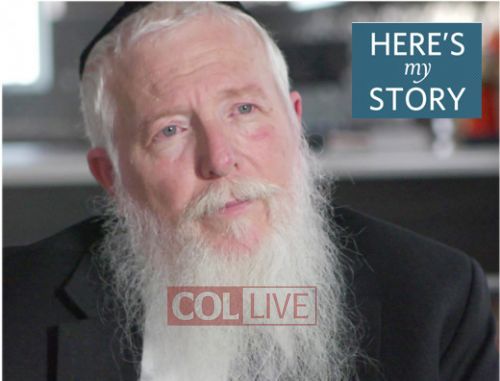
Since 1982, Rabbi Elchonon Lisbon has served as the spiritual leader of Chabad House of Park Heights, Baltimore. He was interviewed by JEM’s Here’s My Story (PDF):
I was born and raised in Worcester, Massachusetts, where I attended the local Chabad day school and, therefore, I got a good grounding in Chassidic teachings as a child.
When I reached Bar Mitzvah age, one of my teachers, Rabbi Velvel Konikov, took me to see the Rebbe, and it was an experience I will never forget.
I remember the Rebbe asking me if I received his letter of blessings for the occasion. I replied that I hadn’t. He immediately made a note to make sure that it should be sent out a second time, and then he gave me a most beautiful blessing.
When I returned to Worcester, I resolved to be a chossid of the Rebbe. This was in 1967, at the time of the Six Day War, just after the Rebbe had launched his tefillin campaign urging every Jew to put on tefillin in order to win added merit for the security of Israel.
It was not an easy thing to do – to go out in the street, walk up to total strangers and ask them to put on tefillin. But the Rebbe said to do it, so I did.
The day after I did it, Rabbi Hershel Fogelman, the dean of my school, called me in and asked, “Did you go out on the tefillin campaign yesterday?” I said that I did, and I told him where I had gone – a suburban neighborhood where I knocked on many doors.
“Do you know whose house you went to?!” he responded. “The Mayor of Worcester, Joseph C. Casdin! And he was so excited that you gave him a chance to put on tefillin.”
As the Rebbe directed, I stayed in Worcester until the 11th grade, and then I joined my brother at the Chabad yeshiva in Montreal, Canada.
But then a problem arose.
While our father was happy that my brother and I were so strongly connected to Yiddishkeit, he felt that he wanted us to make something more of ourselves and, to do that, we had to attend university. Although we wanted to stay in yeshiva, our father was adamant that the time had come for us to leave.
His initial consent that we go to yeshiva in the first place had been quite reluctant, and he was not happy that we were still there. He had a strong resentment brewing inside him, and he decided to go see the Rebbe about it. He knew that the Rebbe had attended university, and he was sure that he could convince the Rebbe to tell us to go university as well.
When I heard that he was going to see the Rebbe, I immediately felt anxious. My father had very strong opinions about our education, and I wasn’t sure that he would be able to contain himself in the presence of the Rebbe. I feared that perhaps he’d express himself in an inappropriate way.
I needn’t have worried. They had a wonderful conversation, lasting about 20 minutes, which totally disarmed my father.
As my father later told me, when he walked in, the Rebbe greeted him warmly, and my father had to respond in kind. But, of course, he made his position known – he argued that his sons do not have to learn in yeshiva all day to be Torah observant Jews. He gave the example of our older brother who went to university and became a public-school teacher while maintaining a religious lifestyle. This is what he also wanted for his younger children. “But if they continue in yeshiva, how will they ever make a living?” he asked.
In response, the Rebbe – with a big, radiant smile on his face – raised his hand upwards and said, “The One Above will send it down from heaven.” And then he moved his hand slowly in a downward motion. My father understood that gesture as bringing down G-d’s blessing.
The Rebbe went on to tell my father that he shouldn’t worry because G-d looks after us. Different people have different missions in this world, but G-d has enough treasures to sustain us all, whatever our life’s calling.
Surprisingly, my father accepted that. In later years, when he would repeat that story to me, a special smile would appear on his face as he remembered the moment the Rebbe nullified all the arguments which he had been prepared to take to the nth degree. He enjoyed recapturing the moment of the Rebbe bringing down G-d’s blessing for us.
Due to the unusual length of the meeting, the Rebbe’s secretary, Rabbi Leibel Groner, came in to the room to see what was taking so long. When he entered for the third time, the Rebbe lifted himself from his chair and instructed him to close the door. The fact that the Rebbe refused to cut the meeting short touched my father greatly.
During the time they spent together, the Rebbe was able – through love – to bring him to a new place. He totally mellowed, his entire disposition changed, and he no longer objected to us staying in yeshiva.
Over the years, I had many audiences with the Rebbe. And although they were not as long or transformative as the one my father had experienced, they were special moments for me.
During one – and I don’t recall exactly when this was – I asked the Rebbe for a blessing to pray properly. I felt that I might not be pronouncing all the words correctly and this concern led me to request a blessing for a more accurate recitation of prayers.
In response, the Rebbe said something very interesting to me. “When you pray, you should pray carefully, using the siddur even if for a little while.”
This seemed like a strange instruction to me – why “for a little while”? The Rebbe himself always used a siddur, even when saying a short blessing after eating cake.
But later, when I worked as the head counselor in a day camp, I realized what the Rebbe meant. At that time, I couldn’t pray from the siddur because I was leading prayers for a couple hundred children and I had to be looking around, making sure that no one was lost. Then I remembered that the Rebbe told me to use the siddur – “even if for a little while” – because there would come a time when I wouldn’t be able to look into the siddur much, so I should do it whenever I had a chance.
So many things I learned from the Rebbe – for example, how to deal with all the distractions and questions that enter one’s mind due to one’s evil inclination and secular surroundings. He said that the best thing to do is to ignore such distractions and think about something else. “Don’t let these things confuse your mind,” he said. “Instead, try to think of a Torah subject, for a little bit of light dispels a lot of darkness.”
At the end of each audience, the Rebbe would look at me for just a second. And that look is something I can never forget. It was the Rebbe saying, “I told you what you have to do, now go do it.” That look was a marching order. It said, “You are my chassid, I am your Rebbe, and I need you to do this.”


thank you Rabbi Lisbon. when we had a problem in Baltimore, Rabbi Lisbon was there at the crack of dawn to help us. THANK YOU. You are a MENTCH
The chabad community in Baltimore is lucky to have you!
Thanks for sharing this awesome and important story. So proud and honored to have you as my Uncle Elchanan –
Devorah Leah
I want to take this opportunity to acknowledge Rabbi Lisbon and thank him for the shining achievements which he has brought to Chabad of the Park Heights Community (Baltimore). With selfless devotion (though he would never toot his own horn) he purchased the current property and renovated the building that is now home to our vibrant Chabad Shul in Park Heights. Without pause for rest he then went on to establish The Baltimore Chabad Cheder (a celebrated major elementary school) in a majestic building. Much of the overall infrastructure and life of the current Chabad community in Baltimore is a… Read more »
Rabbi lisbon is 100% a tzadik
Ariel
Yasher koiach, R’ Elchonon.
I remember the Mivtza Tefillin story very well as I was the one who went with you in the short time we had between Shacharis and the beginning of school.
I have fond memories of your father back in Worcester. He is definitely sitting in Gan Eden looking down with pride at his bonim ubenei bonim oiskim baTorah uMitzvos uShlichus!
Geshmak 🙂
Thanks Rabbi Lisbon
Gershon beck
Oak Park
very inspiring and beautiful! Schoyach!!
“You are my chassid, I am your Rebbe, and I need you to do this.” – beautiful!